Friday, July 16, 2010

Alaska RV Tour - Tok to Fairbanks, Alaska

The 205 mile drive from Tok to Fairbanks was uneventful and pleasant, at least for most of us. Unfortunately, John and Fran Kurz had trouble with a wheel bearing on their 5th Wheel and they had to unhitch and drive around looking for a new bearing. Even with Roger's help it was still a hassle and they missed our great lunch stop at Rika's Roadhouse.

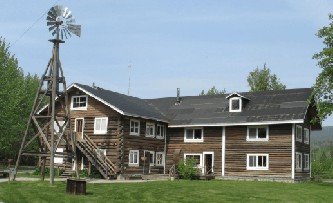
Rika's Roadhouse is in the Big Delta State Historical Park which lays a little ways northwest of Delta Junction, off the Richardson Highway. After the caravan rolled in and got parked, Lynda and I each had a cup of crab bisque and shared a sandwich from the restaurant in the park - the food was delicious! After lunch, we walked around the park and visited the old roadhouse and other sights.

Rika's Roadhouse was built along the Tanana River in 1913 by John Hajdukovich, a Yugoslavian entrepreneur. However it was not until 1917 when Hajdukovich hired a hard-working Swedish woman named Rika Wallen to manage the roadhouse that business really took off. Rika also grew a vegetable garden, cultivated hay, and raised livestock to put good fresh food on the table. Soon the word got out that a weary traveler could enjoy an excellent meal in a warm, clean place and the roadhouse quickly became known as Rika's Roadhouse. Rika bought the place from Hajdukovich in 1923 for "$10.00 and other considerations," probably in lieu of wages.

In addition to Rika's Roadhouse, there are other interesting things to see at the Big Delta State Historical Park, including a Washington Alaska Military Cable and Telegraph System (WAMCATS) station. Lynda and I were tickled to see on display at this station an old Air Force Communications Command (AFCC) patch that we think dates back to the 1960's. We both served in AFCC units during our time in the Air Force and so this was an unexpected link to our own past.

When we returned to the parking lot to leave the park, we learned that Ken and Pat Gunn's coach had suffered a pretty bad windshield crack along the way to Rika's Roadhouse.  Paul and Pat Deragisch were putting clear packaging tape on the crack to prevent it from spreading. This is a trick they learned from a friend and it seems to work.

An hour or so after leaving the Big Delta State Historical Park, we got our first glimpse of the Trans Alaska Pipeline, which parallels sections of the Richardson Highway.  We will be learning more about the history and engineering of the pipeline in a couple days and so for now we just took some photos.


Shortly before reaching Fairbanks, we passed through the town of North Pole (yes, it really exists) and our group stopped to visit the Santa Claus House.

This sort of thing is not really my bag and so I rested in the Trek while Lynda went in to meet Santa.  Here she is with old St Nick.

As we approached the River's Edge RV Park & Campground, we decided to go to Wal-Mart first... we had worked our way through a lot of supplies over the past week or so! So we stocked up on groceries and adult beverages, and also picked up some quick hose disconnects to replenish Spike's supply of spares.

By the way, the average low temperature in January in Fairbanks is a -19 degrees, and the parking spaces at the Wal-Mart  each have an electric power pole so you can plug in your engine heater when you shop in the winter.   Toasty!

We found our way back to the RV park and Val Frye answered our call on the radio to let us know which campsite was assigned to us - the one next to hers. We were glad to see Fran and John Kurz arrive at the campground after a long day of running around to get parts and supplies for their wheel bearing problem.

Depending on where you are in the Yukon and Alaska, the nearest repair facitily or parts store could be over a hundred miles away.  All the more reason to keep spare parts on hand and be extra careful with preventive maintenance!

Spike had nothing planned for the group that evening and so we just settled in and relaxed, which was nice. Click here for photos of our drive from Tok, and stay tuned to hear about our visit to Fairbanks!

Thursday, July 15, 2010

Alaska RV Tour - Dawson City to Tok, Alaska: The Long Way!

We left Dawson City on Wednesday, July 14th. 
Because the Chicken Highway was washed out, we had to backtrack down through Whitehorse, turn southwest toward Bear Creek, Yukon Territory and then finally head northward again to Tok.

Taking this route to Tok added 600 more miles to our journey, compared to going to Chicken and then down to Tok. But the upside to this situation was that we got to drive alongside the beautiful Kluane National Park - something we otherwise would not have done. But, I'm getting ahead of things a bit.

Up to this point in our caravan travels, we had not had any trouble with flat tires. In fact, except for one fairly minor windshield ding on one of the coaches, no-one had thus far experienced problems while we were on the move. Well, these two days going down, around, and back up to Tok changed all that! At least three 5th wheel rigs had trouble with flat tires, and a 5th wheel truck had its back window broken when the driver took a corner too sharply and the trailer edge smashed into the window.  It was just one thing after the next!  Roger was all over the place, coming to the rescue and keeping anxiety down to a low level - I'm not sure what we would have done without him. Spike was also very calm and, true to form, approached each situation sensibly and with safety as his #1 concern. Thankfully, the Trek did not experience any problems but we still felt bad for our friends. And you can bet I was checking our tire pressure every morning!

After stopping at Braeburn Lodge for a quick lunch break, we continued on and turned right (West) onto the Alaska Hiighway at Whitehorse.  After driving another 85 or so miles, we spent the night of July 14th at an RV park in Bear Creek, a small village outside Haines Junction. It had been a long day for everyone and we were glad to stop and rest. 

Leaving Bear Creek that next morning, Joe and Paula Scott's truck had a flat tire and then Ken and Pat Gunn's coach had a flat! We were in the Twilight Zone. Anyway, it worked out OK for both of them: the truck had a spare tire and the coach tire was repaired by a mobile tire repair truck we happened to drive past. That was very fortunate because the Gunn's coach, like ours, does not carry a spare.

Spike had told us the day before that we would be driving through some beautiful areas from Bear Creek to Tok and he was right!  This is when we drove along the eastern edge of Canada's Kluane National Park and up past Destruction Bay. The beautiful scenery and sunshine could not have come at better time - it really revitalized our group!

As beautiful as this area is, the road became increasingly bad with frost heaves (fondly referred to as whoop-de-woos), deep ruts, and random pot holes.  It must be a real challenge to build and maintain good roads on top of permafrost!

A few miles after passing through the Kluane National Park area, we crossed the border once again from the Yukon Territory to Alaska, and now we were back in the USA. Interestingly, the road was much better - I'm not sure what American engineers do that Canadians don't, but there is a definite difference.

By the time we passed through Teslin Junction and then rolled into the Sourdough RV Park in Tok, it was around 6 PM and the weather was cold and rainy again.  We ate dinner at the little restaurant at the RV park - Lynda had the Reindeer chili and it was pretty good (I had a taste of it also). Then we watched the pancake toss. Actually, we both participated in the toss, but Bev Jewson was the only one in our group who got her pancake in the bucket. Oh well, some got talent and some don't.

Click here to see more photos of our drive from Dawson City to Tok, including some photos of the beautiful Kluane area.

Tomorrow, we're off to Fairbanks!

Wednesday, July 14, 2010

Alaska RV Tour - Visit to the No. 4 Dredge: Dawson City

While Consuelo decided to stay in the Trek with the dogs and “clean house,” I thought I’d go ahead and join Spike’s scheduled tour of No. 4 Dredge – I’m so glad I did! I learned about a fascinating piece of history I didn’t even know existed.

Our tour was conducted by the same Parks Canada guide who gave us our historic downtown tour; and she did a fantastic job making what could have been a very dry and technical subject interesting to all of us – even the kids were entertained, and they probably learned something, too!

Our guide began the tour by showing us a diagram of a dredge and explaining its basic operation—a dredge is a huge floating shoveling device that digs out the ground in front of it, sifts and sorts the sand and gravel to sluice out the gold as the material travels through the dredge on big conveyer belts. The left-over material was dumped out the back end and left strewn in huge snake-like wavy piles of rubble, called “tailings.”

As we walked onboard, the guide explained the dredge was built on site in 1912; first they dug a big pond in Bonanza creek because they had to build her right on the water, she was a floating dredge and once built would scoop out the ground in front of her, enlarging the pond, so she could float forward and continue working. The massive beams and lumber for her construction were transported up from British Columbia and Vancouver Island – trees just didn’t grow big enough in the Yukon to provide the necessary materials.

As we entered her lower deck we were all impressed with the massive machinery hidden inside the dredge. Giant flywheels, gears, conveyors and the huge metal tub that agitated the gravel and stone to sift out the gold – Spike had told us earlier that if any oils or lubricants made their way into the water, the gold flakes wouldn’t float out during the sluicing process – so none of these huge moving metal parts were ever oiled. We imagined how noisy it must have been inside the dredge when it was operational.

Our guide told us it had cost just over a million dollars to build this dredge and as we thought about the value of a dollar in 1912, we realized Dredge No. 4 was quite an investment. The guide went on to tell us that the dredge paid for herself in only one year, so it seems the investors behind the gold mining operations had made a good decision.

Dredge No. 4 ran continuously (every day, 24 hours a day with three 8-hour 3-man shifts) from 1912 until she ceased operation in 1959. Why did they shut her down, had they stopped finding gold? We asked. The guide told us the mining company had already surveyed up the valley and determined they could continue to run Dredge No 4 profitably until 1968—and that is actually what they were planning on doing—but in the winter of 1959-1960, they had an extraordinarily cold winter and Dredge No. 4 froze so hard into the ground they couldn’t budge her in the Spring, so they decided to shut her down early. They disconnected her bucket line and laid it down on the ground beside her and abandoned her right there at her last operational site. I had a couple more questions for our guide.

I had been looking in the below decks area for a furnace and steam engine to drive the equipment and gears in this massive mining equipment. The guide told me no, it was all run on electricity; that they actually ran power lines from Dawson City over the hill and down to the creek and when the dredge was working hard, the city would often experience brown-outs as the dredge put a drain on the city’s power.

My next question had to do with the vegetation that grew in the path of the dredge and the guide confirmed that in the year or two before the dredge went through an area, they would send in crews to clear-cut and strip the land around the creek bed. So all the vegetation we saw growing here was only what had grown and filled back in since 1959.

After the tour, we had the opportunity to view a short video about gold mining in the Yukon during the early 20th century. The video contained some fascinating black and white footage of a dredge in operation.

Of final interest to me was the fact that Parks Canada had finally gotten permission from the old mining company in the early 1990s to obtain and maintain Dredge No. 4 as a point of national culture and history. As an important piece of Yukon history, Parks Canada is not doing anything to “beautify” or correct the destruction the dredge left in her wake – they’re not replanting vegetation, filling in ponds and they’re even leaving her bucket chain laying on the ground, right where it was left.

Click here to see photos of our trip to Dawson City, including the No. 4 Dredge.

Alaska RV Tour - Dawson City, Yukon Territory

Dawson City is our favorite place so far - this town has so much character and is so interesting!  We arrived on July 9th and left July 14th, one day later than originally planned.

For several days before arriving in Dawson City, Spike had been telling us that we would need to get used to about 18 hours of daylight. He was not kidding. During the time we were in Dawson City, we found ourselves walking the dogs after midnight just about every night... it was still daylight and our body clocks failed to tell us to get some sleep. By 4 AM, it was becoming light again and we were up and about by 6 or 6:30 AM almost every morning. We actually enjoyed these extended days, although if we had stayed in Dawson City much longer we may have collapsed suddenly :-)  I guess these summer daylight hours make up for the long DARK days during the winter.

After we arrived and got our RVs situated, Spike led our group around town to introduce us to the layout. This did not take long as Dawson City is pretty small! While we were there, Lynda and I ran into the hardware store to try to find some replacement hose attachments... we've been having trouble with a dripping connection at the water manifold. Anyway, no luck with that but Spike came over later and gave us some quick disconnects, which did the trick. Spike rules!

The next morning (Saturday), our group went into town to take a historic tour of the town. Parks Canada interpretive guides do an amazing job with such things, to include wearing authentic period dress. We very much enjoyed this two hour tour.

After the tour we went back to the RV park and ate lunch at the restaurant next door with Jim and Bettye Chaplin.  Then Spike gathered us all up once more and off we went to the Midnight Dome.

The Midnight Dome is a metamorphic rock that stands at slightly under 3000 feet and is just a few miles outside Dawson City. This hill is a popular sightseeing destination and is named the Midnight Dome because for decades people have been gathering on the top of the hill to watch the midnight sun and the changing colors of the night sky. The views from the Midnight Dome are beautiful - you can clearly see see the confluence of the Yukon and Klondike Rivers, Dawson City, the Klondike Valley, Bonanza Creek, Top of the World Highway and the Ogilvie Mountains.

After enjoying the view from Midnight Dome, Spike took us part way down the hill to the Royal Canadian Mounted Police (RCMP) cemetery, which contains graves from 1893 to 1904 and is next to the Klondike cemetery.  It was interesting and sad to visit these cemeteries.  There are several young Mounties buried in the RCMP cemetery that died when trying to save others during boating accidents at the height of the Klondike Gold Rush. According to Spike, this cemetery is considered almost sacred by the RCMP even today. 

While there are many graves of interest in the other cemeteries that surround the RCMP cemetery, one in particular caught my eye: the grave of Jan Welzl (1868-1948).  Welzl was apparently an intelligent eccentric, explorer, inventor and author. He was born in Czechoslovakia and led a life of adventure and discovery across the north. Each year small delegations of followers from around the world visit this site to conduct memorial services. A black, iron cross and Czech flags mark his grave site.  As you can see from the photo, many visitors to his grave leave gifts.

After visiting these cemeteries, we went into town for a tour of Jack London's cabin.  Lynda and I are both fans of Jack London, although its been years since I read his books.  It was so interesting to see his cabin and learn more about London's life and writing.
By the way, Spike recently finished reading White Fang, which is what he calls Barley.  Sydney is known as Little Crazy Girl - I wonder why?
Just up the road from Jack London's cabin, on 8th Avenue, is the log cabin that Robert Service lived in between 1909 and 1912. I've mentioned Robert Service at least a couple times in prior postings - he is known as the Bard of the Yukon and is renowned for his writings on the Canadian North, including the poems "The Shooting of Dan McGrew", "The Law of the Yukon", and "The Cremation of Sam McGee". His writing was so expressive that his readers took him for a hard-bitten old Klondike prospector, not the later-arriving bank clerk he actually was.  Anyway, we enjoyed hearing about Robert Service from another Parks Canada Interpreter, who finished up his presentation by reading several of Service's humorous poems.

After the Robert Service readings, we headed back to the RV park to freshen up, walk the dogs and get ready for Gold Panning - oh yeah, we were just moments away from striking it rich! 

So off we went, at least most of us, up to the Klondike Visitor's Association (KVA) Claim on Bonanza creek to try our luck.  I really had fun and so did Lynda. We both found some gold flakes and I found (with Spike's coaching) a small gold nugget.

Then we headed back to the RV park and got cleaned up to go out with Roger and Teresa to Diamond Tooth Gertie's Casino, Canada’s oldest gambling hall.  This place puts on three shows a night, hosted by "Gertie" and her Cancan dancers.  You can get something to eat and drink while watching the show, and you can also try your luck at blackjack, roulette, Texas Hold'em poker, and a bunch of slot machines.  Although we did not gamble, we did enjoy some pizza and beer while watching the show.  It was a fun night but by the time we got back to the RV, I was worn out - it had been a long and eventful day! 

The next day was Sunday and Lynda went on the tour of the famous No. 4 Dredge, which is the biggest wooden hull, bucket-line gold dredge in North America. It rests on Claim No. 17 on Bonanza Creek, off Bonanza Creek Road where we panned for gold.  The No. 4 Dredge is maintained by Parks Canada.  Anyway, I skipped this tour to vacuum the RV and catch up on email.  Living with two shedding dogs in an RV requires constant cleaning!  Look on our Blog for a separate posting from Lynda about this tour.

After our visit to Dawson City, our group was scheduled to take the George Black Ferry across the Yukon River on Tuesday. This is the only practical way to reach Chicken, Alaska from Dawson City. We had been hearing stories about this "rustic" ferry from various sources, including the motorcycle rider we ate dinner with in Hyder. As it turns out, that guy was telling the truth!  The George Black Ferry really does crash-land on the opposite shore and, if needed, the ferry attendant will set down planks so you can drive your RV off without bottoming out on the mud and gravel.  Groovy!

Most of us were really looking forward to visiting Chicken, with its booming population of 17 (including children).  Chicken is the setting of the book "Tisha", the autobiography of Anne Hobbs who came to Chicken as its only teacher in the 1920s. Several of us in the group had read the book and were looking forward to seeing Anne's schoolhouse cabin.
 
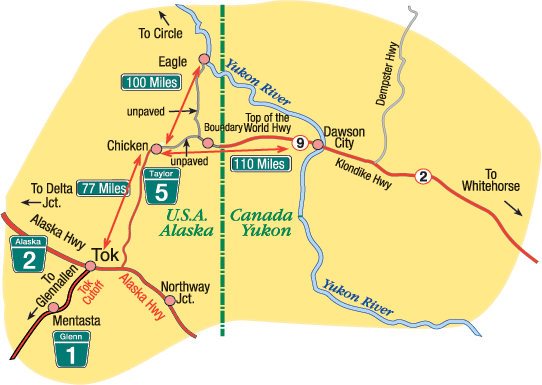
Anyway, around midday on Sunday, Spike put the word out that the road from Dawson City to Chicken was washed out and we might not leave on Tuesday as planned. This road is actually comprised of two sections:  Yukon Highway 9, known as the Top of the World Highway, that runs from Dawson City to the Canadian-US border and the Taylor Highway on the US side that  connects Chicken, Alaska with the Canadian-US border. Above is a map from the http://www.alaska101.com/ web site that shows this interesting roadway.
 
From what Spike could find out, the road was washed out on the US side and several cars and RVs were caught between the damaged areas.  Anyway, the plan was to just sit tight while he checked with various contacts to get a better idea of when the road would be repaired.
 
After lunch on Sunday, our group went on a tour of the Commissioner's Residence in Dawson City. According to Parks Canada:

In July of 1897, the federal government appointed a commissioner to head the government of the newly declared Yukon Territory. Very quickly, Dawson City grew from a city of tents and shacks to a modern metropolis, boasting churches, hotels, a school and a hospital. Perhaps more than any other building, the Commissioner's Residence represented the confidence the government had in this new town and its prospects.  This building has gone through its share of trials and tribulations, including a fire in 1906. 

... Although occupied by several commissioners and their families, undoubtedly the most memorable were George and Martha Black, the last full time residents. The Blacks occupied the house from 1912 to 1916. During their stay, they welcomed all levels of society from humble miners to foreign dignitaries. From lavish furnishings to the formal gardens, Martha's special interest in the residence represented a cultural oasis in the wilderness. Dawsonites were proud to show visitors a level of hospitality comparable to southern centres and so much contrast with the mud, gravel and simple cabins found in the goldfields. Both the Blacks went on to play important roles in the political life of the Yukon over the next several years.

The Commissioner's Residence really is a handsome building! We enjoyed the tour and admired the wonderful restoration work that has been done on the first floor. The second floor has not yet been restored, but hopefully Parks Canada will be able to fund work on the rest of the building over the next few years. 

After the tour, Spike drove us past the George Black ferry so we could get a first-hand look at it. Seeing the ferry up close only made some of us more nervous about driving our RVs onto that little vessel. But Lynda and I, being old hands at ferry-riding, were looking forward to it!
 
As Sunday wore on, it grew wetter and colder.  Spike's plan to go gold panning again that evening was scrapped, except by a few hardy souls who went back up to the KVA claim on their own.  We elected to stay home and watch a movie. That night, when we were walking the dogs in the daylight of midnight, we saw a beautiful Red fox. I am sure if we did not have the dogs with us we could have gotten within 20 feet of him... he was that bold!  Unfortunately, we did not get a photo of that particular fox, but here is a photo I took of another Red fox that looks just like him. These little guys are very pretty creatures and, although they look like a dog, they move more like a cat.

Monday's weather was better. But we were all disappointed when Spike put the word out that it was beginning to look unlikely that we would be going to Chicken. He found out that the damage to the road was extensive and it might take days or even weeks to get the road repaired. In fact, he was busy making alternate plans for travel routes, RV parks, and tour schedules.  He said we would wait one more day but if the Chicken road was not re-opened within the next day, we would have to leave Dawson City on Wednesday and take the long way back down and around to Tok, Alaska stopping in Bear Creek for the night and bypassing Chicken altogether.

After taking the dogs for a walk over the bridge toward Dawson City, I rode the scooter out to the KVA claim.  I had to go veeeerrrrry slowly because the road is mostly gravel and it would not take much for that scooter to slide out from under me. Even so, it was a nice ride.  On my way back, I found myself behind Val Frye's car - she had stopped to feed beef jerky to a Red fox. That little fellow knew exactly what he was doing; he came up to her car and sniffed round for a handout. Then a second car came along and the fox ditched Val for a better handout - popcorn!  The people in the second car seemed to know this fox and what he likes to eat. 

It was sometime Monday afternoon that Irene and Snake Simpson invited us to go into town with them to "The Pit", supposedly the oldest bar in Dawson City. The Pit is very much a local watering hole and is located in a somewhat dilapidated pink building.

So off we went, and after we got there Jim and Bettye Chaplin joined us also. Well, it turned out to be one of those nights.  At one point a local guy sat down, fixed his glassy eyes on us and said, quite clearly, "pardon me for evesdripping on your conservation." Well, that was the beginning of the end for us. 

A few gallons of beer later, the others left to see the show at Diamond Tooth Gertie's (the evesdripper had also stumbled away by now) but Lynda and I remained at the bar.  We ended up hanging out with a local woman who worked for Parks Canada as an Interpretive guide for Dredge #4.  What a fun time we had !  Here is a photo of the table where we partied. 

Anyway, at some point Teresa found us and got us back to the RV park safe and sound. When I thanked her the next day, she said that Irene had run into her at Gertie's and asked her to check on us.  Good thing, or we might have ended up in a sod-roofed cabin, working for Parks Canada.

Anyway, enough about that.

The festivities of the night before certainly slowed down our day on Tuesday - we were just a tad under the weather and did not feel like doing a whole lot other than laundry. Spike announced that we would leave the next day to drive the long way to Tok, Alaska - 600 miles of backtracking! 

Well, true to form, the group decided to make the best of things and we used the radios to organize a potluck for dinner. I borrowed the Bland's jeep and went into town to the market and bought some steaks for us and some milk to make Tapioca for the potluck.  That tapioca was a big hit! 

In keeping with our weather luck so far, the potluck got rained-out half  way through the meal so we all scattered back to our RVs to finish off our food.  After a while, we emerged to gather under the overhang by the Park's office to celebrate Alma Banks' birthday and eat some cheesecake - hey, we sure know how to party!

And so we left Dawson City on Wednesday, July 14th after a fun-filled and eventful visit.  Lynda and I really liked it there and would love to go back... perhaps for a winter experience?  Probably not, considering the average low temperature in January is -31 degrees!

Click here for Dawson City photos.

Next, on to Tok, Alaska via Bear Creek - stay tuned!

Friday, July 9, 2010

Alaska RV Tour - Onward to Dawson City, Yukon Territory

We left Whitehorse on July 9th and drove north on Highway 2 toward Dawson City, also in the Yukon Territory.  This was about a 330 mile drive over mostly good roads, although we did hit one stretch of gravel road that was pretty bad.  But more about that later.

We stopped at Braeburn Lodge, south of Carmacks, to sample their gargantuan Sticky Buns. These buns measure about 10 inches across and about 4-5 inches high! We bought one and will try to consume it over the next several days.

The population of the Yukon is small and folks know each other.  Also, dog racing is a big thing here and we were quickly learning that a lot of people are involved. For example, Braeburn Lodge hosts a checkpoint of the long-distance Yukon Quest race each February. 

Back on the road, we continued northward to Pelly Crossing for our lunch stop.  Lynda and I peeled off from the caravan just short of Pelly Crossing to get a burger from Gramma's Kitchen, and little roadside grill along the highway that is owned by First Nation people.

After lunch, our caravan continued northward when we came upon that 4 mile gravel patch I mentioned above. It figures that after days of rainy, cool weather today was actually dry and so that gravel road was dusty! We drove our rigs slowly, leaving plenty of room between us to avoid rock damage and allow the dust to settle a bit. 

Nevertheless, our RVs were a mess by the time we traveled through this construction area!  Here is a photo of the scooter after traveling this road for only a couple miles.

But the worse of it was that the Mounties were allowing only one lane of traffic at a time while a fatal accident scene was getting cleaned up ahead of us.  Apparently someone in a minivan was going too fast on the gravel - the vehicle left the road at a high rate of speed and flipped at least once. How sad that someone got killed... the dust on our vehicles did not seem that big a deal once we learned what had happened. We were all a bit subdued after the info passed down the line of vehicles.

While we were waiting to proceed at the gravel road, Spike radio'd us to look out for a Trek like ours that was heading our way.  Here is a photo I snapped of that other Trek.

Shortly before reaching Dawson City, we made a quick stop off the highway at the Tintina trench plate separation.  Spike set up a golf tee and some of our men-folk took turns seeing who could launch a ball the furthest.  But the joke was on Bob Billings, who asked for first shot.  Spike had a "special" ball for him - one that exploded when hit.  Lynda witnessed this and told me the expression on Bob's face was priceless!

We finally rolled into the Bonanza Gold RV Park around 5:30 PM.  We decided to fill up with gas before settling in and so drove the Trek next door to the gas station.  And this is where we paid the most for gas so far:  $4.97/gallon, after a "discount". Wow.

Anyway, we're here and looking forward to seeing more of the infamous Dawson City! Click here for some photos of today's drive up from Whitehorse.

Alaska RV Tour –Whitehorse, Yukon Territory

We arrived in Whitehorse on Tuesday, July 6th and left the morning of Friday, July 9th. We stayed at the Pioneer RV Park, which is a very large RV park with lots of facilities located just a few miles outside of town.

We actually did not care much for the RV park, or at least for the lower area which is like a parking lot and quite dusty (or muddy when wet). But Pioneer does have hookups, discounted fuel ($4.15/gallon) wireless internet, good laundry facilities, and they also have… wait for this… a dog wash! Yep, a dog wash just like you would find at a grooming shop. So Barely and Sydney got a much-needed bath while we were in Whitehorse!

Pioneer RV Park has an upper area in the trees that we went and checked out. At the end of the RV tour, we will probably come back through Whitehorse on our own and stay at Pioneer again, but this time on the ridge in the trees – it’s nice up there!

Wednesday was a big day. That morning, we rode in Spike’s van to visit the Whitehorse Rapids Fish Hatchery and Miles Canyon. The Fish Hatchery was very interesting but the Salmon are not running yet and so we were not able to see them in action. Nonetheless, it was a good tour and we learned more about the Salmon lifecycle and how the hatcheries tag and track fish.

Then off we went to Miles Canyon, a steep and narrow canyon with 50-foot high basaltic walls through which the Yukon River flows. During the Gold Rush, hundreds of boats loaded with supplies were lost trying to go through this canyon before the Northwest Mounted Police arrived to regulate traffic. Eventually a wooden rail system around the canyon eliminated the need to take boats through Miles Canyon and the hydroelectric dam constructed to provide power to Whitehorse has gentled the canyon waters.

The Robert Lowe Bridge was built in 1922 and is a foot-traffic suspension bridge that spans Miles Canyon. It is named for Robert Lowe who came to the Yukon in 1899 and became a long serving local and territorial politician. Lynda did walk across this bridge but she was a little uncomfortable with the swaying movement. I loved it, of course.


The kids, Sophie, Roxie, Weston, and Zach, had fun sliding down a hill by the bridge. I tried it also but my shoes were “too grippy” according to Sophie, and so I could not get much speed built up.

We returned to the RV park for lunch and I decided to skip the afternoon tours to the SS Klondike and the Beringia Center. Lynda did go, however, and has already made some postings about those tours. She very much enjoyed them and I was kind of sorry I skipped out once I heard how good they were. Oh well, I needed a rest!

We almost missed Val Frye's birthday celebration shortly before dinner on Wednesday. By now, the FM two-way radios had become our group's primary means of communication all the time, not just while we're driving.  We had accidentally turned our volume all the way down and missed Carlos' announcement to gather by their RV for cake and singing. Anyway, we heard the singing and were able to make it out there just in time.

Wednesday evening our group gathered for a grilled steak dinner in the event hall at Pioneer RV Park. Our guest of honor that night was Michelle Phillips, accompanied by her partner Ed and their son Keegan. As I wrote in a prior posting, Michelle is the #1 rated woman musher in Canada and most recently won the GinGin 200. She has also raced in the Yukon Quest several times and ran the Iditarod earlier this year. Spike is one of her corporate sponsors and he is very enthusiastic about her abilities and mushing in general.

The food was very good and it was extremely interesting to hear Michelle speak about becoming a musher and what it is like to run long races such as the Yukon Quest and the Iditarod. It’s hard to believe people (and dogs) actually complete these races in sub-zero temperatures under the most austere conditions! It costs a lot of money to buy the necessary equipment, train and feed the dogs, and to enter the races. As did many in our group, we made a donation to Michelle to help fund her racing efforts. This is something she does because she loves the sport, and we appreciate and admire her fortitude. Good luck, Michelle!

By the way, it was while we were in Whitehorse that we noticed the days were getting really long. It was daylight by 5:30 AM and did not get dark until almost 11 PM. These daylight hours will expand even more as we continue going north.

Thursday was a free day with nothing specific planned by Spike until that evening. So we cleaned the RV, did some laundry, washed the dogs, and I borrowed Linda and John Bland’s jeep for a beer run into town. This is when we fully realized how high-priced beer is in the Yukon. For example, we paid around $24 for a 12 pack of Kokanee beer, which is similar to Coors. Oh well, what the heck - we stocked up anyway!

We wrapped up our visit to Whitehorse on Thursday evening, when Spike took us to see the Frantic Follies which is a turn of the century vaudeville revue which depicts the entertainment seen by the pioneers of the Great Klondike Gold Rush of 1898. There were readings from the works of Robert Service (The Bard of the Yukon), Cancan dancing, singing, and more. As promised by Spike, this show was BIG fun. In particular, they did a fabulous rendition of Robert Service’s The Cremation of Sam McGee  which had us laughing to tears!

Click here for photos of our Whitehorse visit.

On Friday morning, July 9th, we left Whitehorse and headed to Dawson City - Land of the Midnight Sun. Stay tuned!

Wednesday, July 7, 2010

Alaska RV Tour - Visit to the Beringia Museum, Whitehorse

After we were done looking at the SS Klondike, we loaded back up into Spike’s van and he drove us over to the Beringia Museum. Also run by Parks Canada, this museum focuses on the Beringia land mass and the animals and humans that likely traveled to and from Asia and North America using the “bridge” formed during the last ice age. 

First, a Park guide spoke to us, and by showing us a huge globe, he helped us understand how much the continents have changed over the millennium. He explained that there’s no proof of one way traffic across the land bridge and that likely animals and humans traveled back and forth between the two continents.

He told us scientists generally agree that the prehistoric horse moved from North America to Asia, then went extinct in North America and that humans, mammoths and other large prehistoric mammal such as the giant bison, the giant beaver and saber-tooth cats came to this continent from Asia.

Next a woman guide took us into the auditorium and gave us a presentation on the tools early humans would have used for hunting. She talked about spears and explained how early hunters designed their spears so the shaft would detach and they wouldn’t lose the whole weapon when an injured animal ran off with it. She also demonstrated a tool the hunters used to extend the range and increase the accuracy of their spears. Finally she led us all outside to where some targets were set up so anyone who wanted could try their hand at throwing a spear at a woolly mammoth. Of course, all the kids jumped right in— Zach, Weston, Sophie and Roxie. Ultimately, Weston proved to be the most handy with his spear.


Seeing the fun the kids were having, several of the men in the group decided to give it a go. I recall John Kurz, John Bland, Tim Woolums and Neil Brown all trying to show their women they could be good providers! 

After some peer pressure from the others, I found myself standing up front with a spear in my hand. Sophie patiently showed me how to hold the spear and the launching tool. Good thing I’ll never have to kill something with a spear! Despite my best effort, I forgot to let go of the spear and everything landed with a clatter about 6 feet in front of me.  Oh well, I’d probably do better if I was hungry and really in truly needed to bring the beast down…at least I hope so!

Alaska RV Tour - Tour of SS Klondike, Whitehorse

While Consuelo stayed back at the Trek with the dogs, I joined Spike’s scheduled tour to go look at the stern wheeler SS Klondike. The boat is on display in a public Park at the edge of the Yukon River in downtown Whitehorse with tours conducted by Parks Canada (the equivalent of our US National Park Service).

The Klondike began her life in 1929 as a working boat to transport goods up and down the Yukon River between Whitehorse and Dawson City. By the 1930s, the gold rush in the Klondike was well over and there was less of a need to transport supplies, so the SS Klondike was converted over to carry passengers.

Parks Canada has preserved the Klondike in much of her original condition as a passenger stern wheeler and I was interested to see the galley kitchen with its enamelware pots, huge cook-stove and silver coffee urn.


The formal dining room for the first-class passengers was beautiful. But, we learned the third-class passengers received their meals crammed into a tiny little galley area with the crew. The first-class cabins on the upper decks were also quite interesting to look at. Each cabin contained a set of very narrow bunk beds - not even as wide as a twin bed. Most cabins had a sink and toiletry area in one corner and carpeting on the floor.

After going up top to look at the wheelhouse, we headed down below decks to check out the engine room. The Klondike was a steam driven stern wheeler and, as such, her lower deck housed a vast wood-burning furnace, intricate pipes and valves and giant pistons to turn the stern wheels.

I found it very interesting to learn that even though the Klondike was originally built for transport and she had lots and lots of storage space in her below decks area; she still didn’t have room to carry enough lumber (i.e. fuel) to make the entire trip from Whitehorse to Dawson City! So, she and all the other stern wheelers like her would travel north and stop at towns along the way to refuel. Many (if not most) of the towns along the Yukon River between Whitehorse and Dawson City originated as small lumbering operations to fuel the stern wheelers, and so most of the trees were stripped from the land around the river.

Here is one last thing our Parks Canada guide shared with us that we all thought was most fascinating: Back in the 1960s when Parks Canada decided to move the SS Klondike from the other side of town where she had last been docked when she was taken out of commission, the challenge was how to move her. They put logs across the main street of Whitehorse and lubricated them with thousands of gallon s of Palmolive dish soap. Then, they just slid her down the street and put her in the park. – That must have been quite a sight to see!

Tuesday, July 6, 2010

Alaska RV Tour – Skagway to Whitehorse, Yukon Territory

We left Skagway the morning of July 6th the same way we came in, traveling the Klondike Highway up and over the Coast Mountains.

It was very foggy when we left Skagway and, once again, we drove our RVs separately instead of in a caravan. This way, folks could go up that mountain as slowly or as quickly as they wished (or their RV could handle), and could also cross the border without creating a traffic jam.

That fog was like pea-soup and I told Lynda I was glad it had not been like that when we came down the mountain into Skagway… it would be a lot worse driving in that fog going down a steep road than coming up! 

Our group met at the Carcross Vistor Center parking lot, formed a caravan once more, and then we went on to our lunch stop at the Caribou Crossing Trading Post just a few miles outside Carcross. This place turned out to be well worth the stop!

After we ate lunch, we had plenty of time to roam around and enjoy the Wildlife Museum, play with some Alaskan Husky puppies, and learn more about the Iditarod race. Lynda and I were so impressed with the Wildlife Museum! There are animals on display there that surpass anything I’ve seen in major museums in the lower 48! Unfortunately, we did not have the camera with us but you can visit the Caribou Crossing Trading Post web site and look at some photos there. We also had fun playing with some puppies and we watched a taped interview with Michelle Phillips in which she talked about mushing, the Yukon Quest and the Iditarod.

All in all, the Caribou Crossing Trading Post was a very pleasant afternoon stop! Then our caravan hit the road again, heading to Whitehorse with just one more stop on the agenda: a place called Emerald Lake.

Emerald Lake has an intense green color which is attributed to light reflecting off white deposits of marl, a mixture of clay and calcium carbonate, at the bottom of this shallow lake. The high level of calcium carbonate found here is the result of deposits from glacial erosion. Emerald Lake proved to be gorgeous and well-worth the stop!

As we approached Whitehorse, Lynda and I decided we needed to stock up on some groceries and so we let Spike and Herb know we would be bypassing the Pioneer RV Park to head straight into town to do some shopping. We found the Wal-Mart pretty easily (thanks to the GPS) and got our shopping done.

We were amazed at the large number of RVs that were in the Wal-Mart parking lot! These folks had their awnings and camp chairs out, their grills set up… the whole works! It was evident that several had been there for a while. The Whitehorse Wal-Mart is the only place we’ve seen this so far.  Sure, many RV travelers will overnight at a Wal-Mart on their way somewhere to save money and for the convenience of the shopping – we do this quite often ourselves. But this was the first time we saw people actually camping in a Wal-Mart parking lot. Things are different here, that is for sure! Anyway, we made our way back to the Pioneer RV Park without any trouble and got settled into our spot that Herb set aside for us.

Click here for some photos of our drive from Skagway to Whitehorse.

Here we are in Whitehorse – stay tuned!